The RayOne Galaxy (Rayner) is marketed as the first « spiral » intraocular lens (IOL) for continuous range of vision. This page has two distinct parts. Part 1 describes spiral optics from publicly available sources only (patents and the optics literature), as I wrote it before having access to the lens. Part 2 summarizes our independent optical bench study of the RayOne Galaxy itself, measured with a high-resolution Mach–Zehnder interferometer and published open access in Biomedical Optics Express (2026). The measurements show that the Galaxy does not rely mainly on the strongly « spiralized » geometry described in Part 1.
Key findings at a glance
- The RayOne Galaxy is a refractive (non-diffractive) extended depth-of-focus (EDOF) IOL.
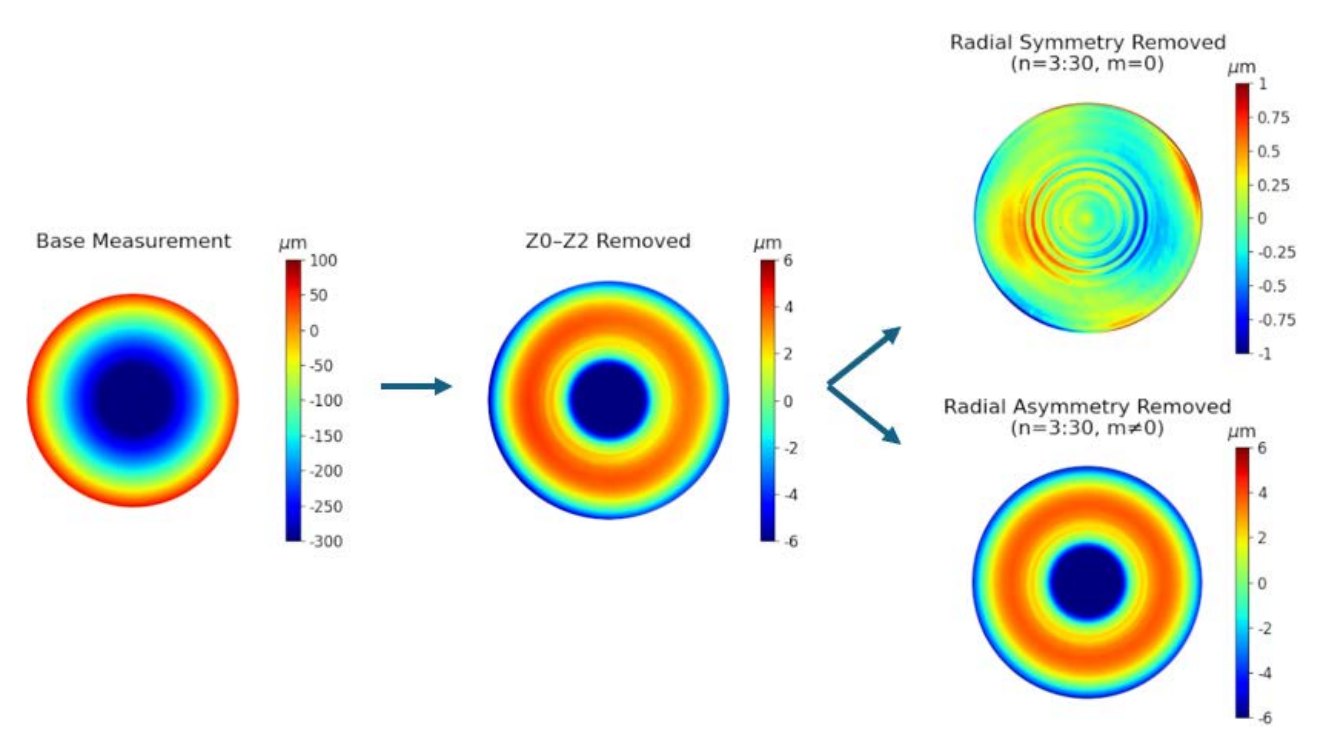
- A double-spiral phase structure is indeed present on the optic, but its amplitude is small (about one micron of optical path difference) and it only becomes visible after removing Zernike terms up to very high orders.
- The depth of focus is produced mainly by rotationally symmetric spherical aberration (negative primary and positive secondary spherical aberration), not by the spiral itself.
- On the bench, the Galaxy gives a smooth, continuous through-focus profile (simulated usable range of about 2.5 to 3 D), with lower peak contrast than a monofocal lens and a smoother PSF (fewer ring-shaped halos) than a diffractive trifocal.
What is the RayOne Galaxy IOL?
The RayOne Galaxy is a single-piece, preloaded hydrophilic acrylic IOL from Rayner (Worthing, UK). It shares the RayOne platform: Rayacryl material (26% water content, refractive index 1.46, Abbe number 56), 6.0 mm biconvex optic, 12.5 mm overall diameter and closed-loop haptics. Rayner describes it as an aberration-correcting lens with a refractive spiral surface designed to extend the depth of focus, and as a « full range of vision » lens. The exact geometry of the spiral is not disclosed by the manufacturer.
Early clinical results are encouraging. In a multicenter pooled series (73 patients, 146 eyes), Abela-Formanek et al. reported a smooth binocular defocus curve with visual acuity of 0.2 logMAR (20/32) or better from +1.00 D to −2.80 D, with generally mild halos and glare and no severe cases. In a pseudophakic vision simulator, halo size was smaller with the Galaxy than with the RayOne diffractive trifocal (11.4 vs 21.0 mrad).
The question is therefore: how does a « spiral » IOL extend depth of focus? Part 1 explains the theory; Part 2 shows what we actually measured.
Part 1. Spiral optics and spiral diopters: what the public literature says
Note: this section is based only on public sources (patents, published articles) and on my own Zemax simulations. It does not come from Rayner and was written before we could measure the Galaxy.
The literature on spiral optics applied to ophthalmic lenses is relatively sparse. The oldest patent I found on spiral multifocal ophthalmic lenses dates back to 2002–2003 (US 2003/0117577 A1, « Multifocal ophthalmic lenses »). More recently, a patent on a « spiral diopter with meridians of different powers » (EP 3990979 A1, see also BR 112022009802 A2) described the equations of the technology in detail, and was applied to a contact lens. The corresponding scientific article by Galinier et al. (Optica 2024) provides a very useful foundation to describe « spiral diopters ». Rayner describes the Galaxy as having « additional refractive power variation inserted along spiral tracks », which made it reasonable to look for functional analogies.
Generalities on spirals
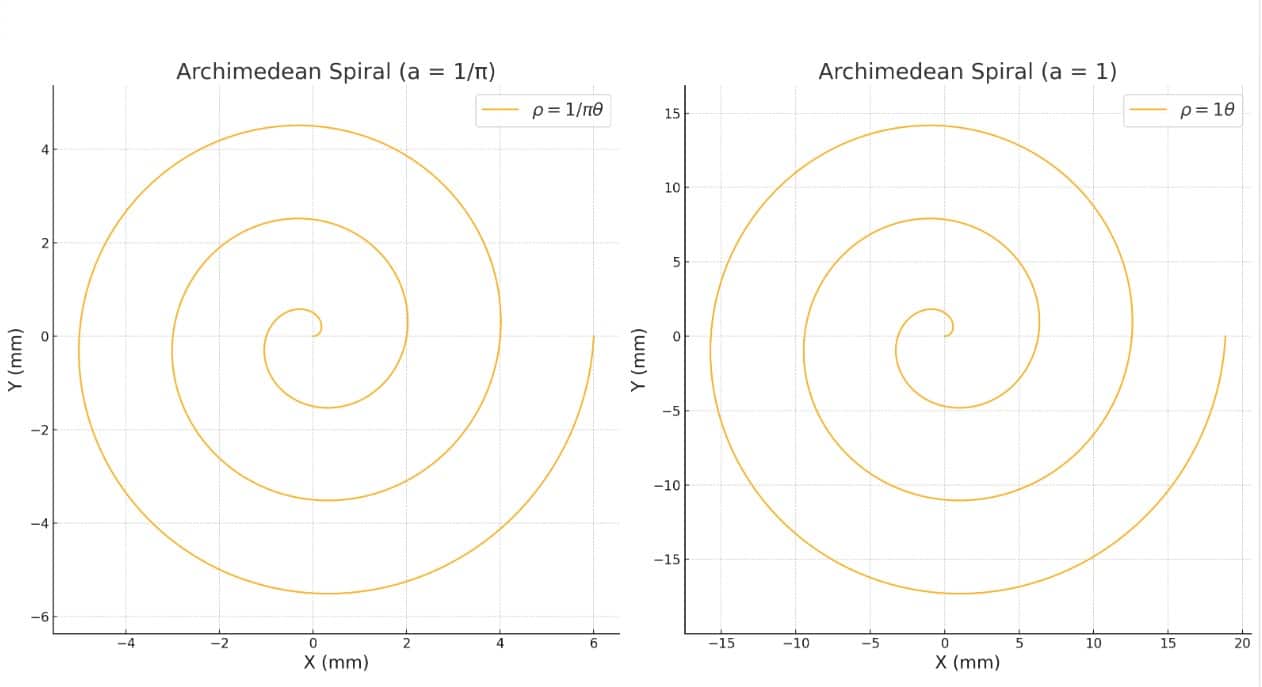
A spiral is a curve that moves progressively away from a central point while turning around it. Spirals are found in mathematics, physics, biology and engineering: the logarithmic spiral of snail shells (related to the golden ratio), the hyperbolic spiral (infinite coiling at its center), or the Archimedean spiral, in which the spacing between turns is constant. The groove of a vinyl record is an Archimedean spiral, defined in polar coordinates by ρ = bθ, where θ is the angle in radians, ρ the distance to the origin and b a constant controlling the spacing between turns. For example, with b = 0.5 and θ = π (180°), ρ ≈ 1.57.
Analytical description of a spiral diopter
In the approach of Galinier et al., the local curvature C of the surface alternates between two values c1 and c2 along spiral tracks:
C(r, φ) = (c1/2)·[1 + cos(Nφ + ηρ²)] + (c2/2)·[1 − cos(Nφ + ηρ²)]
- c1, c2: the two curvatures (powers) between which the surface alternates; their difference sets the amplitude of the spiral pattern.
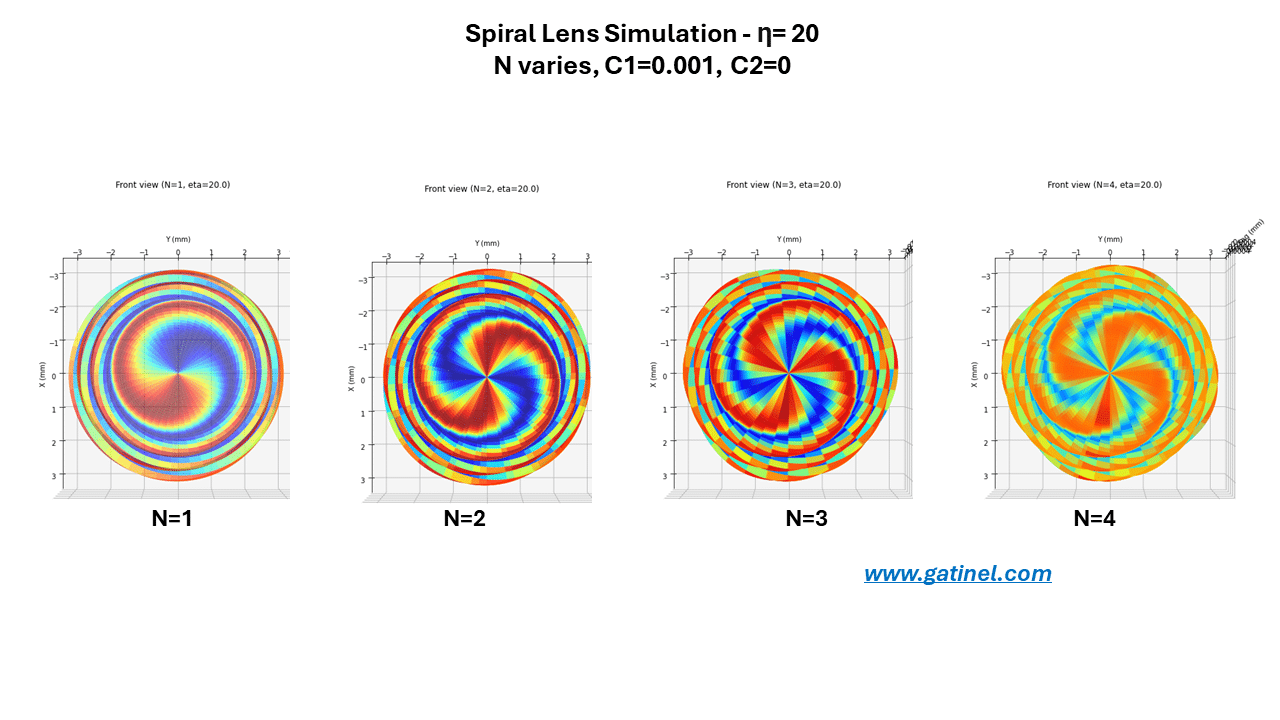
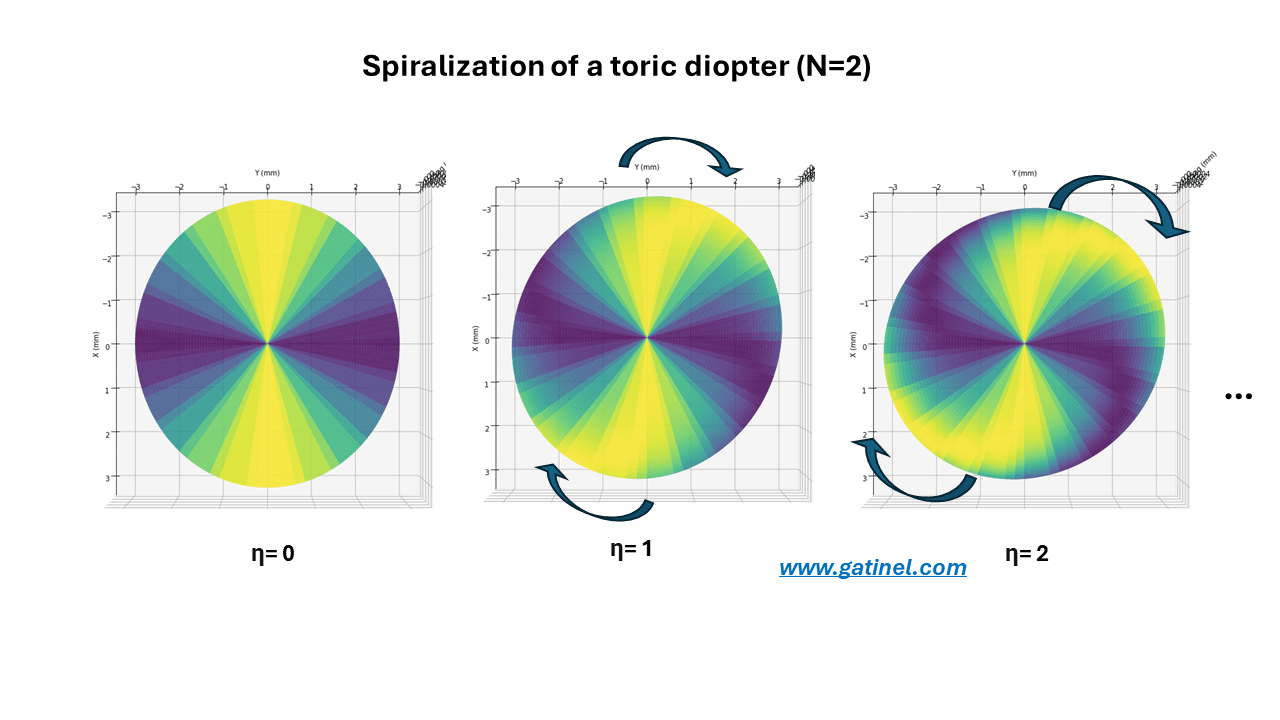
- N: number of branches (meridians); N = 2 corresponds to a toric surface.
- η (eta): degree of spiralization (twist of the branches around the optical axis); η = 0 gives straight meridians.
- ρ = r/R: radial coordinate normalized to the maximum radius R of the optic; φ is the azimuthal angle.
The cosine argument combines an angular part (Nφ) and a radial part (ηρ²): the shape of the pattern depends on both angle and distance from the center, and the twist increases toward the periphery.
Visualization of a spiral diopter
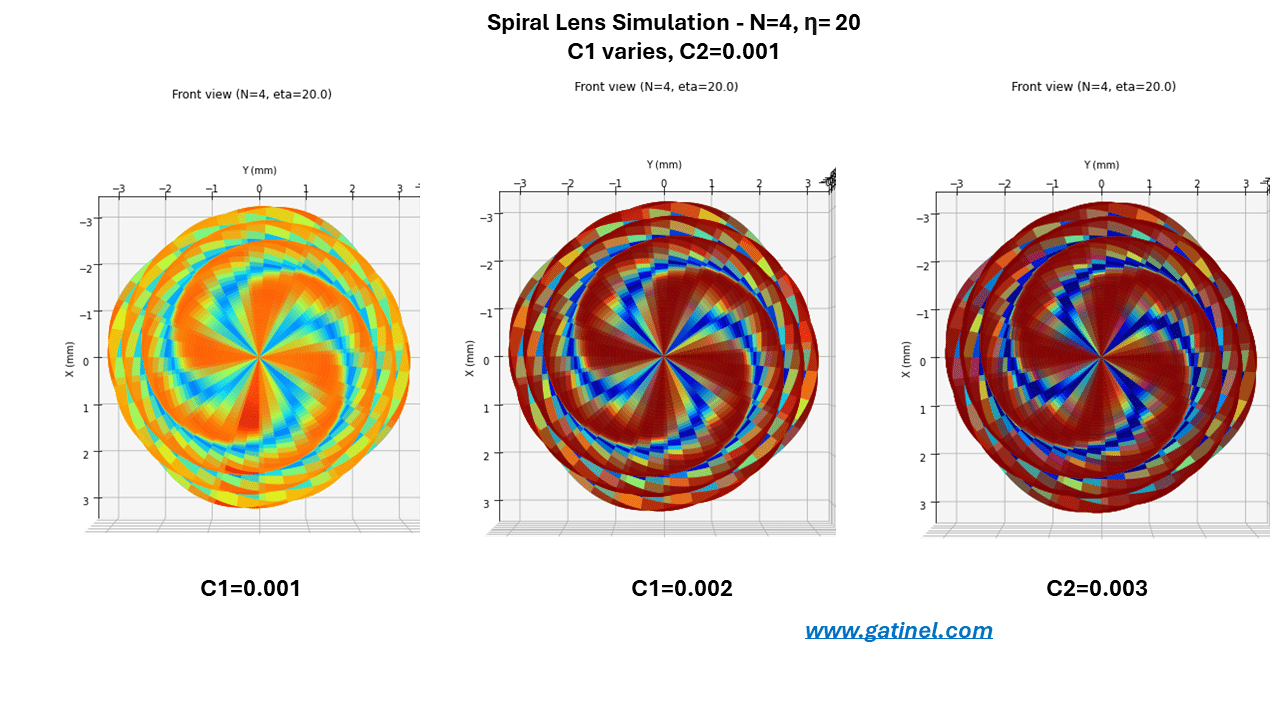
By adjusting c1, c2, N and η, very different spiral surfaces can be obtained.

Optical impact of a strongly spiralized surface (Zemax simulations)
The starting point is a toric lens (N = 2, η = 0), whose two principal focal lines define a range in which some depth of field exists. Spiralizing the diopter (increasing η) redistributes the light intensity while keeping it mostly between the main foci.
Consider now an IOL whose surface has two principal meridians of different power arranged in four alternating spiral branches (N = 4), twisted around the optical axis. To simulate it in Zemax (Ansys), the equation of C was used with an elevation (sag) variable instead of curvature. These theoretical simulations show how such a toric and spiral surface refracts incident rays.
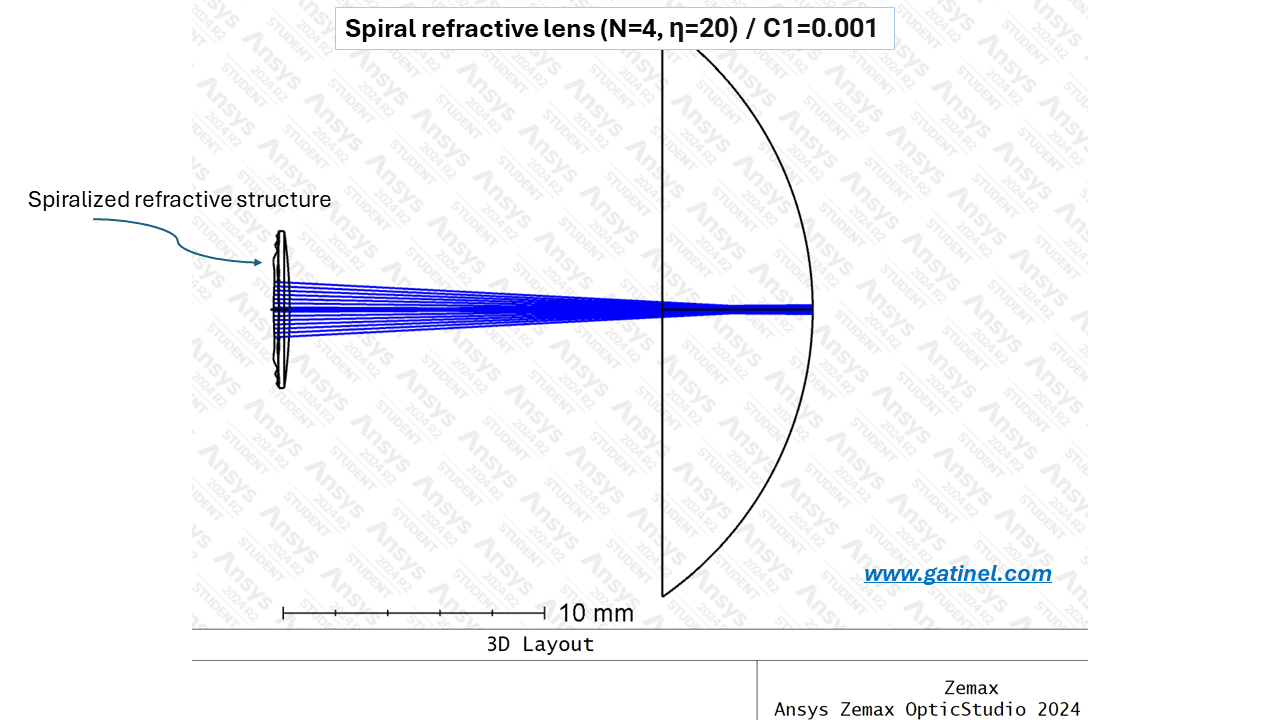
Through-focus MTF, convolved images and through-focus spot diagrams can then be computed (Arizona eye model, 5 mm aperture stop).
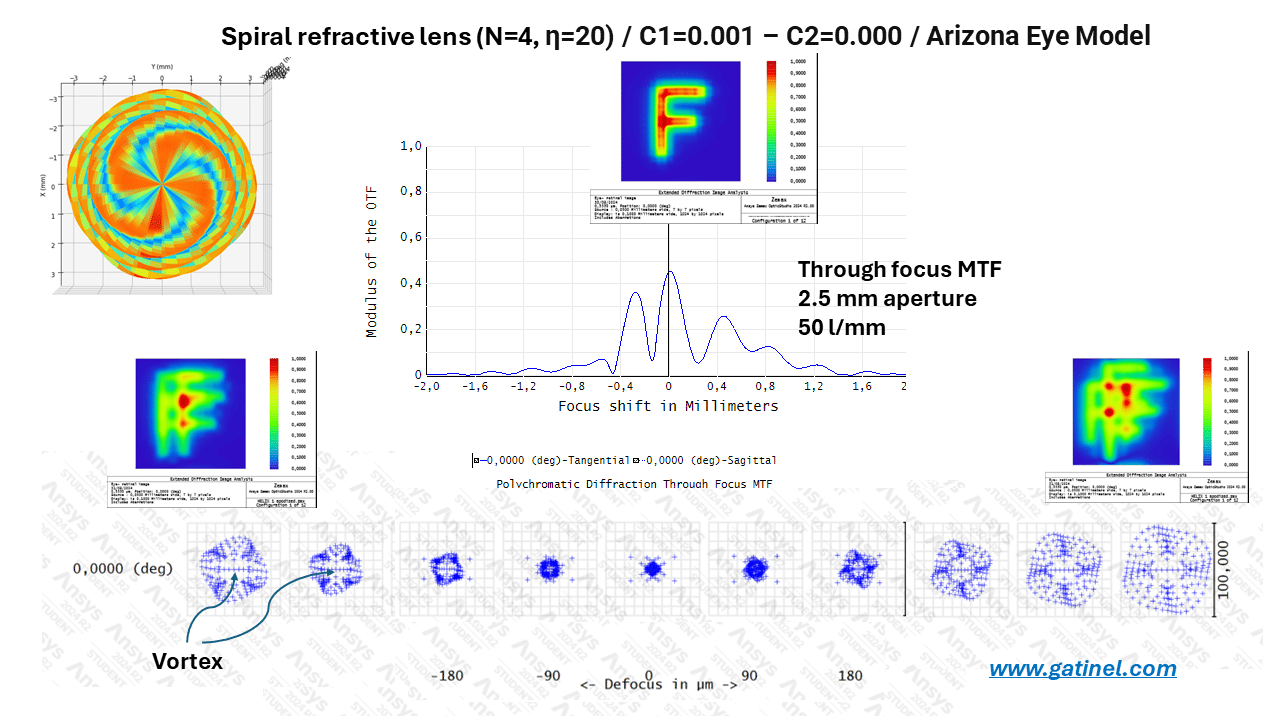
In this model, the through-focus MTF shows three peaks: one in front of and one behind the focus of the monofocal carrier optic. They result from the peripheral « wrapping » of rays induced by the spiralization, which creates a relative intensity deficit at the center of the beam (vortex). Unlike a diffractive lens, whose added foci are all on the near side (for example +1.75 D and +3.50 D), the vortex effect spreads the focus on both sides of the carrier focus (for example −1.50 D and +1.50 D). Outside the focal zone, convolved images show « ghost » replicas linked to the grouping of certain ray bundles. With a high coefficient (c1 = 0.1), the rays form three particularly dense zones in the focal region (red arrows).
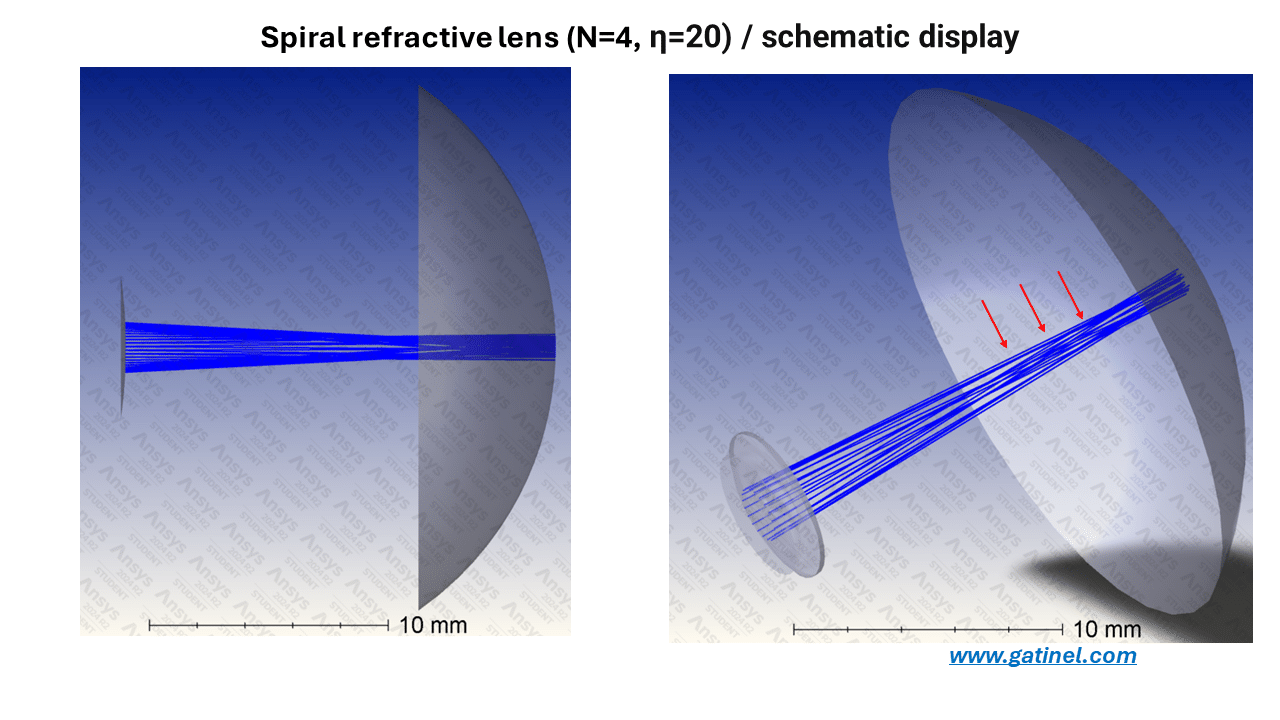
Important: these simulations describe a surface where the spiral modulation covers the whole aperture with a large amplitude. As shown below, the real RayOne Galaxy behaves very differently: its spiral component is subtle, and it does not produce vortex-like PSFs or distinct foci on both sides of the carrier focus.
Part 2. What the RayOne Galaxy actually does: independent optical bench study
We characterized the RayOne Galaxy in vitro and compared it with three other IOLs: the RayOne Aspheric monofocal, the RayOne Trifocal (diffractive) and the Isopure (BVI, a refractive EDOF lens based on controlled spherical aberration). The full article is open access: Gatinel D, Entin A, Stern B. In vitro optical characterization of the RayOne Galaxy spiral extended depth-of-focus intraocular lens using high-resolution Mach–Zehnder interferometry. Biomedical Optics Express 2026;17(7):3984–4001. To our knowledge, it is the first independent optical characterization of this lens.
Methods in brief
- Wavefronts measured with a phase-shifting Mach–Zehnder interferometer (NIMO TEMPO, Lambda-X), 543 nm, 3000 × 3000 sampling points (1.8 µm pixels), lenses immersed in water.
- Lenses: 22 D Galaxy, 20 D RayOne Aspheric, 20 D RayOne Trifocal, 19 D Isopure (power differences compensated by a paraxial lens).
- Zernike decomposition up to radial order 30 (496 modes) to separate low-order aberrations from fine phase structures.
- Optical performance computed in a pseudophakic Arizona eye model (Zemax) at 3.0 mm (photopic) and 4.5 mm (mesopic) pupils: through-focus MTF at 50 lp/mm and MTFa (0–50 lp/mm), PSF, encircled energy and simulated retinal images of a Sloan letter « E ».
Wavefront: a real but subtle double spiral
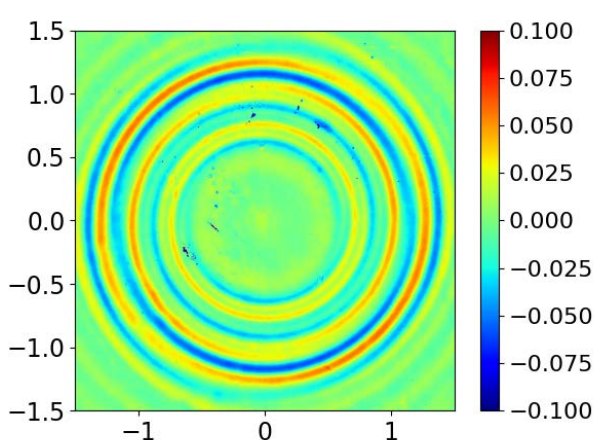
Raw wavefronts are dominated by defocus and look similar for all lenses. After removing low-order terms, the Galaxy shows a central pattern typical of negative spherical aberration, plus fine concentric ring-like structures of much lower amplitude than the diffractive rings of the trifocal.
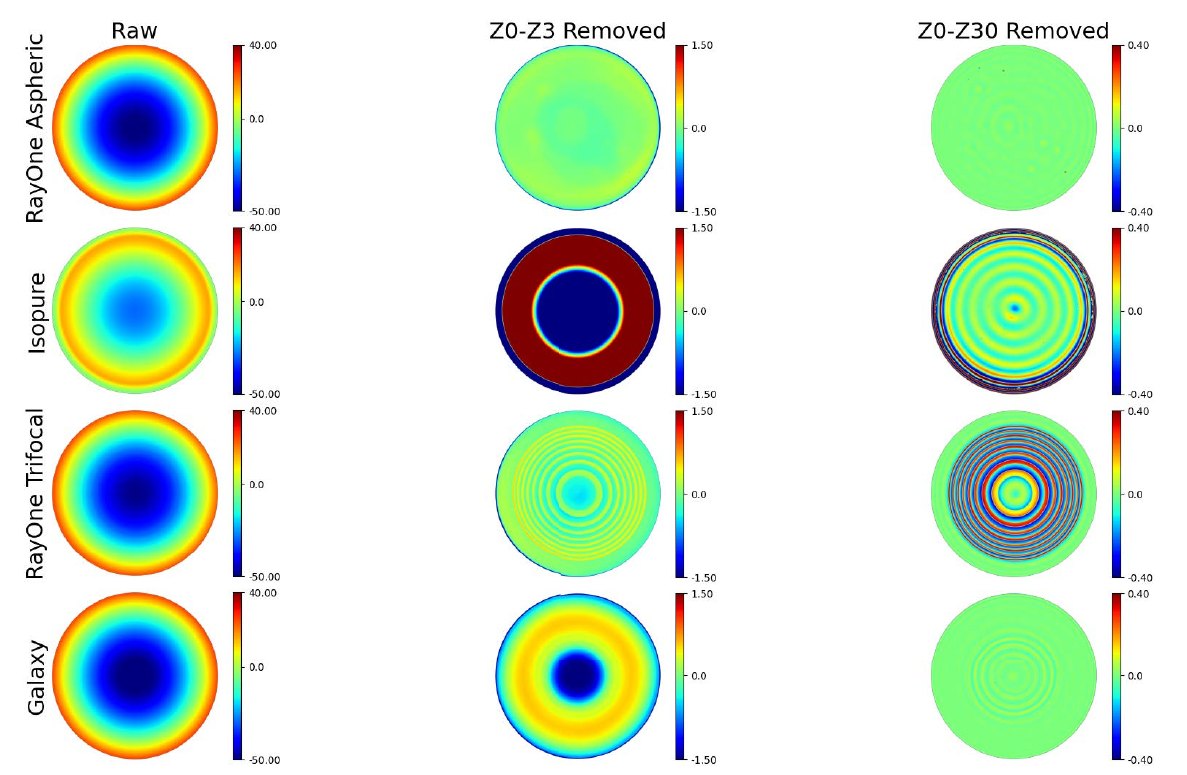
Are these rings truly concentric or subtly spiral? Pushing the Zernike decomposition to radial order 40 and looking at the central 3 mm reveals the double-spiral pattern consistent with Rayner’s description. The amplitude is very small (about ±0.1 µm in this residual map).
A specific spherical aberration signature
Over a 4.9 mm pupil, the Galaxy has a negative primary spherical aberration (Z40 = −0.443 µm), between the RayOne Trifocal (−0.073 µm) and the Isopure (−1.316 µm). Unlike the Isopure, whose spherical terms are all negative, the Galaxy has a positive secondary spherical aberration (Z60 = +0.137 µm). Because the r² components embedded in Z40 and Z60 then add up instead of cancelling, the radial phase profile becomes less monotonic: different annular zones carry different effective curvatures, which spreads energy over a wider defocus range.
Through-focus MTF: a continuous EDOF profile
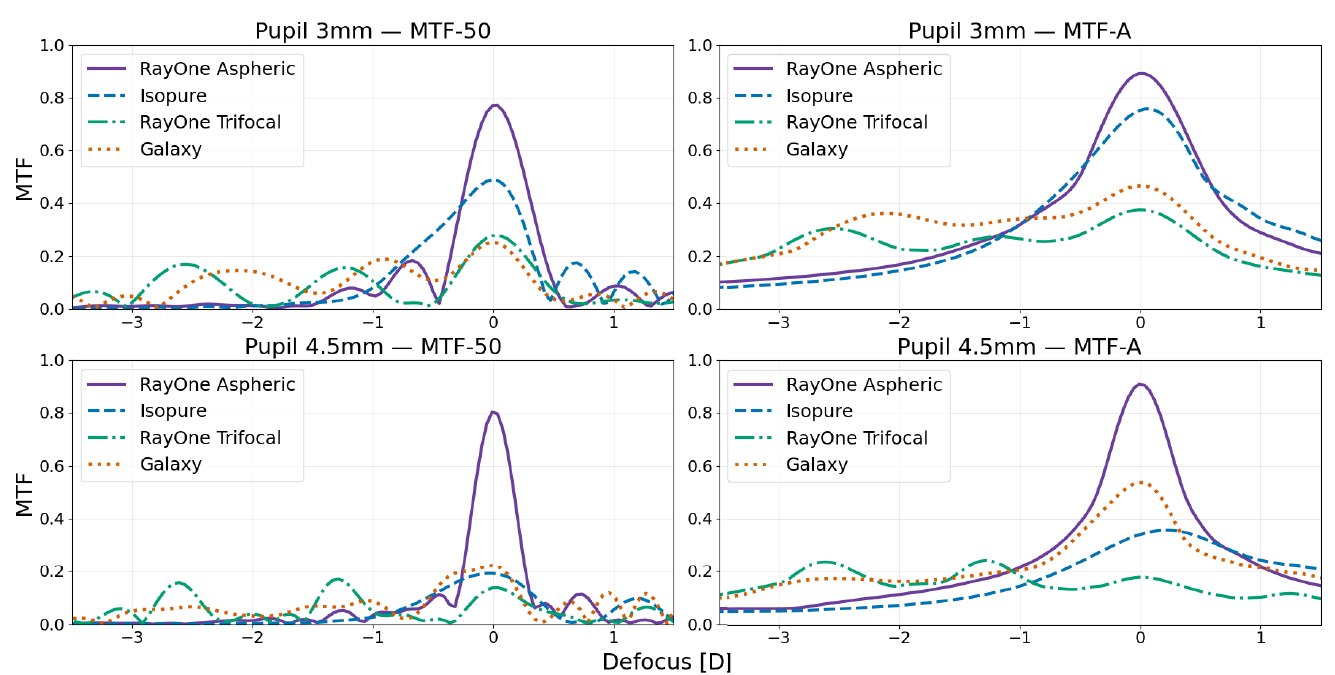
| IOL | Peak MTF (50 lp/mm), 3.0 mm | Peak MTFa, 3.0 mm | Peak MTF (50 lp/mm), 4.5 mm | Peak MTFa, 4.5 mm |
|---|---|---|---|---|
| RayOne Aspheric (monofocal) | 0.77 | 0.89 | 0.80 | 0.91 |
| Isopure (EDOF, spherical aberration) | 0.49 | 0.76 | 0.19 | 0.36 |
| RayOne Trifocal (diffractive) | 0.28 | 0.38 | 0.17 | 0.24 |
| RayOne Galaxy (spiral) | 0.25 | 0.47 | 0.22 | 0.54 |
The Galaxy has a lower peak MTF at distance than the monofocal lens, but a broader and more continuous through-focus curve. It does not produce the discrete secondary peaks of the trifocal: two low-amplitude secondary bumps remain smoothly blended. Its performance is also relatively stable with pupil size (MTFa 0.47 at 3.0 mm vs 0.54 at 4.5 mm), whereas the Isopure degrades markedly at 4.5 mm.
Simulated vision through focus
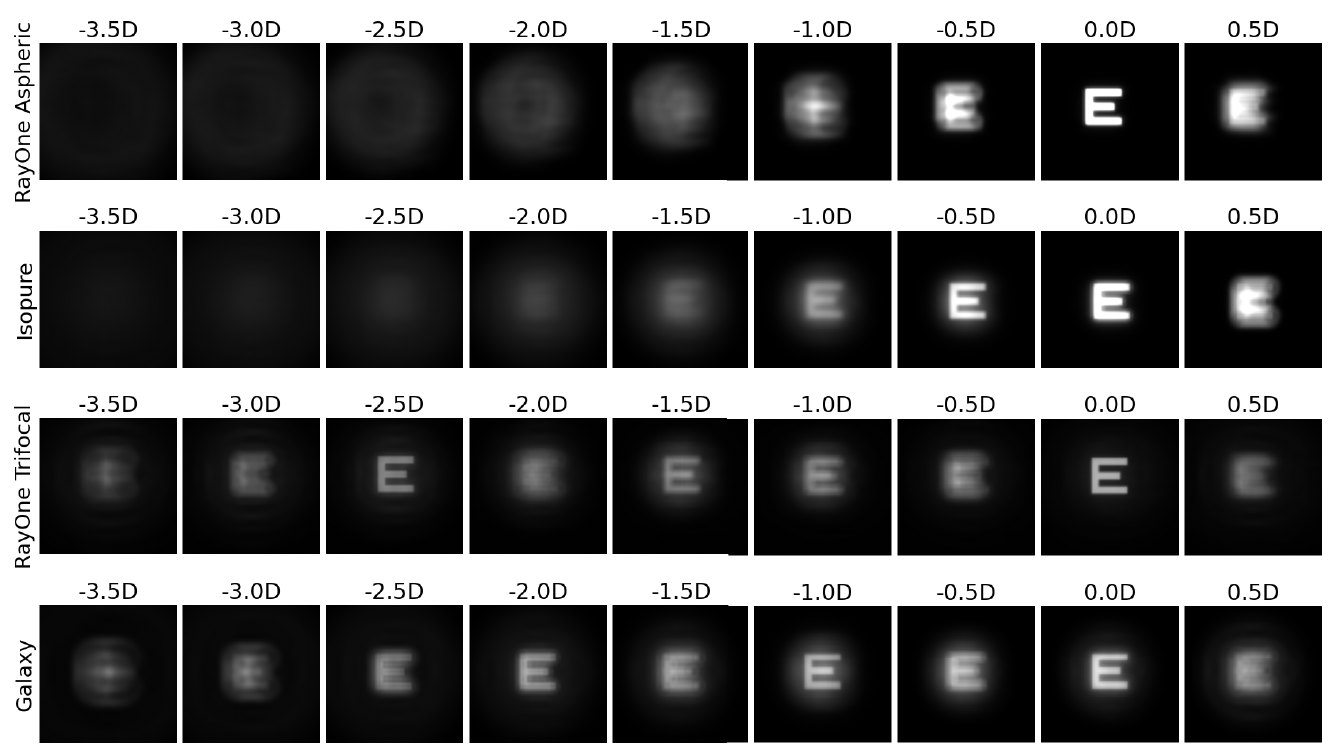
At 3.0 mm, the monofocal keeps a recognizable « E » only from about 0 to −0.5 D, the Isopure from 0 to about −1.5 D, and the trifocal shows separate zones of relative clarity. The Galaxy keeps a recognizable letter continuously from 0 to about −2.5 D, with a gradual loss of sharpness rather than abrupt transitions. At 4.5 mm, the Galaxy still provides a continuous range down to about −3 D, with lower contrast.
PSF, encircled energy and halos
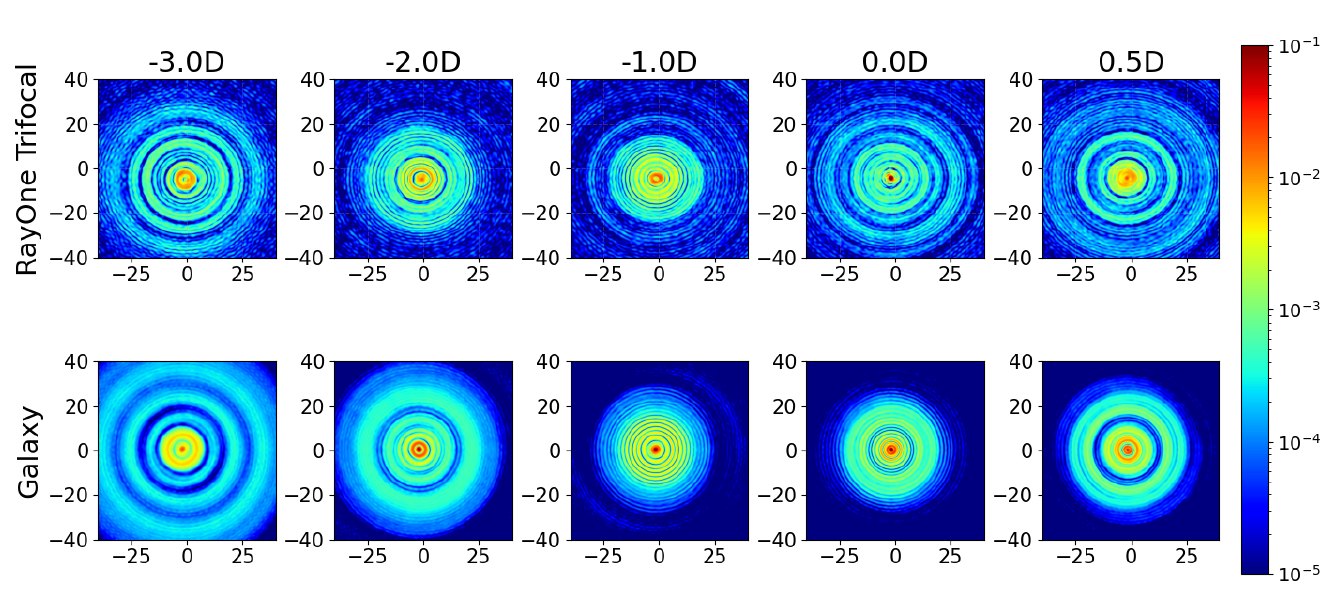
The trifocal PSF shows pronounced concentric rings at all defocus levels, the optical signature of diffractive halos. The Galaxy PSF is smoother, with a central lobe that broadens progressively with defocus without splitting into discrete maxima. Encircled energy curves place the Galaxy between the monofocal and the trifocal. This is consistent with the smaller halos reported clinically and in vision simulators.
Is the spiral responsible for the extended depth of focus?
To answer this, the Galaxy wavefront was split into its radially symmetric components (m = 0) and its non-radially symmetric components (m ≠ 0, which contain the spiral). The spiral part has an optical path difference of about 1 µm, roughly an order of magnitude smaller than the rotationally symmetric profile (about 6 µm).
The functional test is clear: with only the non-radially symmetric modes (spiral included), the through-focus curve collapses to a narrow monofocal-like peak. With only the radially symmetric modes, the full EDOF behavior of the Galaxy is reproduced at both 3.0 and 4.5 mm pupils. In addition, a Zernike reconstruction up to radial order 20 already reproduces the raw through-focus behavior, before the fine spiral structure is even captured.
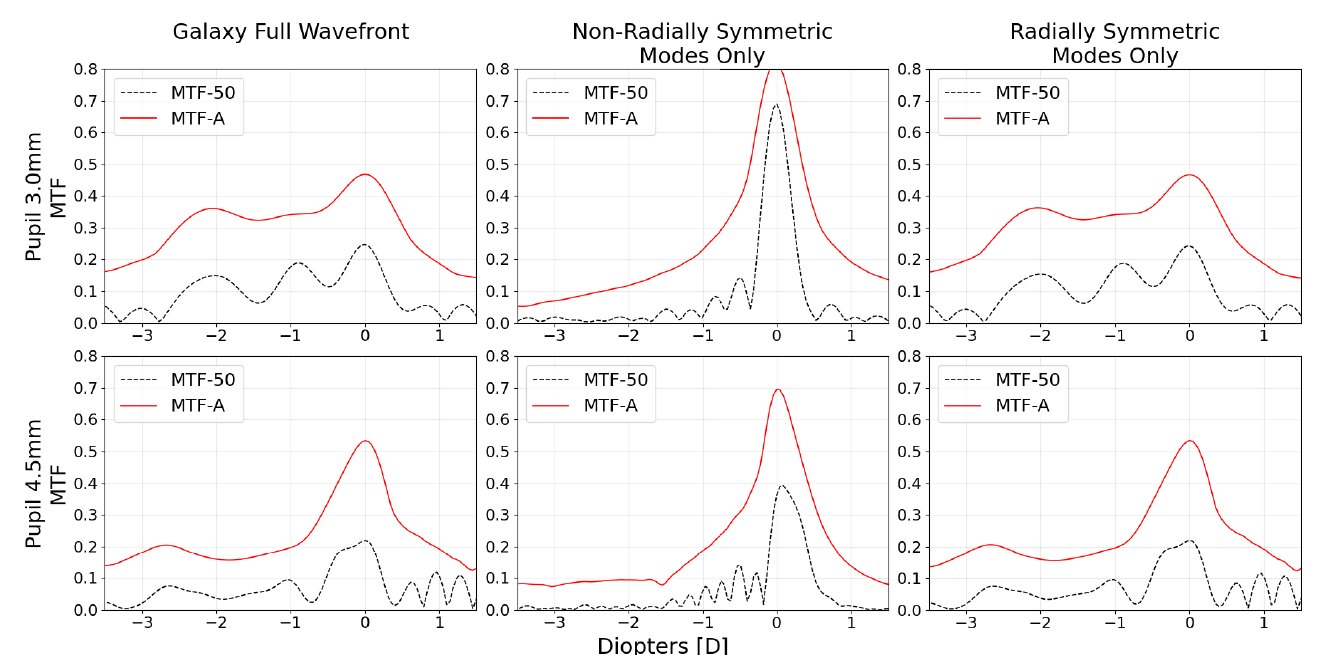
In short: the RayOne Galaxy behaves as a refractive EDOF lens driven mainly by rotationally symmetric spherical aberration. The spiral is real but plays a secondary role in monochromatic depth of focus. It may still play a role in other aspects (distribution of halo energy, chromatic behavior, tolerance to decentration), which were not tested.
Limitations of the bench study
- One lens per model was measured, so manufacturing variability could not be assessed.
- Simulations were monochromatic (543 nm); chromatic effects were not included, so values are likely an upper bound of in vivo contrast.
- Isolated IOLs in a standard eye model: no individual corneal aberrations, no decentration or tilt.
- Analysis limited to a 4.9 mm diameter.
RayOne Galaxy vs other EDOF and trifocal IOLs
| IOL | Material | Mechanism | Through-focus behavior on the bench |
|---|---|---|---|
| RayOne Aspheric | Hydrophilic acrylic, n = 1.46 | Monofocal, aberration-neutral | Highest peak contrast, narrow depth of focus |
| Isopure (BVI) | Hydrophobic acrylic, n = 1.53 | Controlled negative spherical aberration | Moderate extension, strongly pupil-dependent |
| RayOne Trifocal | Hydrophilic acrylic, n = 1.46 | Diffractive trifocal (4.5 mm ring zone) | Discrete foci, ring-shaped PSF |
| RayOne Galaxy | Hydrophilic acrylic, n = 1.46 | Refractive: spherical aberration profile + subtle spiral | Continuous range (about 2.5–3 D simulated), smoother PSF, moderate pupil dependence |
FAQ about the RayOne Galaxy
Is the RayOne Galaxy a diffractive lens?
No. Its wavefront contains no diffractive steps; it is a refractive lens. Its depth of focus comes mainly from a specific spherical aberration profile.
Does the spiral create the depth of focus?
Not primarily. On the bench, the radially symmetric part of the wavefront alone reproduces the full EDOF behavior, while the spiral component alone gives an almost monofocal response.
What depth of focus can be expected?
Simulations suggest a continuous usable range of about 2.5 to 3 D under ideal conditions, consistent with the clinical defocus curve reported by Abela-Formanek et al. (0.2 logMAR or better from +1.00 to −2.80 D).
Does the Galaxy cause halos?
Its PSF is smoother than that of a diffractive trifocal, with less ring-shaped energy, which is consistent with the smaller halos reported in clinical and simulator studies. Halos are not zero, and individual perception varies.
How is it different from the « spiral diopter » lenses described in the literature?
In the spiral diopters described by Galinier et al., the spiral phase covers the whole aperture with a large amplitude and can generate vortex-like PSFs. In the Galaxy, the spiral component is about ten times smaller than the rotationally symmetric profile and has a limited optical effect.
Conclusion
Spiral optics are an elegant concept, and the theory (Part 1) shows how a strongly spiralized surface can split and spread the focus. The RayOne Galaxy, however, achieves its extended depth of focus mostly through a carefully designed rotationally symmetric spherical aberration profile, with a subtle double-spiral structure whose exact role remains to be clarified. Optically, it sits between a monofocal and a diffractive trifocal: lower peak contrast than a monofocal, but a smooth, continuous through-focus profile without the ring-dominated PSF of diffractive optics. Clinical studies on pupil dependence, dysphotopsia and tolerance to decentration and tilt are still needed. This page aims to give clinicians the optical background behind the marketing narratives, to support more informed decisions.
References
- Gatinel D, Entin A, Stern B. In vitro optical characterization of the RayOne Galaxy spiral extended depth-of-focus intraocular lens using high-resolution Mach–Zehnder interferometry. Biomed Opt Express 2026;17(7):3984–4001. doi:10.1364/BOE.596696 (open access).
- Galinier L, Renaud-Goud P, Brusau J, et al. Spiral diopter: freeform lenses with enhanced multifocal behavior. Optica 2024;11(2):238–263.
- Abela-Formanek C, Amon M, Auffarth GU, et al. Performance of the first spiral refractive intraocular lens for continuous full range of vision. J Refract Surg 2025;41(11):e1213–e1222.
- Jones LG, Clutterbuck TA. Multifocal ophthalmic lenses. US Patent Application US 2003/0117577 A1, 2003.
- Villemagne N, Joannes L, Stern B, et al. On bench evaluation of intraocular lenses: performance of a commercial interferometer. Biomed Opt Express 2024;15(11):6588–6605.
Disclosure: this page is independent and was not sponsored by Rayner. Damien Gatinel is a consultant for BVI (manufacturer of the Isopure IOL) and receives royalties. Figures in Part 2 are reproduced from the open access article cited above (Optica Open Access Publishing Agreement).