Refractive Surgery • Technology
Femtosecond Laser: Mind-Blowing Facts
Astonishing numbers and analogies behind the technology that creates LASIK flaps
Femtosecond lasers are highly efficient devices for creating LASIK flaps with excellent visual outcomes. Their widespread use should not overshadow some particularly impressive features of this technology. Here is a summary of mind-blowing numbers and analogies that help grasp the extraordinary physics involved.
What does the prefix « femto » mean?
The prefix « femto » designates a fraction equal to 10−15, or:
0.000000000000001
One-millionth of a billionth
A femtosecond (fs) corresponds to a duration of 10−15 seconds. This is an inconceivably brief instant of time.
How short are the femtosecond pulses?
The duration of a femtosecond is so infinitesimal that it is difficult to wrap one’s mind around it. To help understand this scale:
Analogy #1
A femtosecond is to a second what 1 second is to 32 million years
Analogy #2
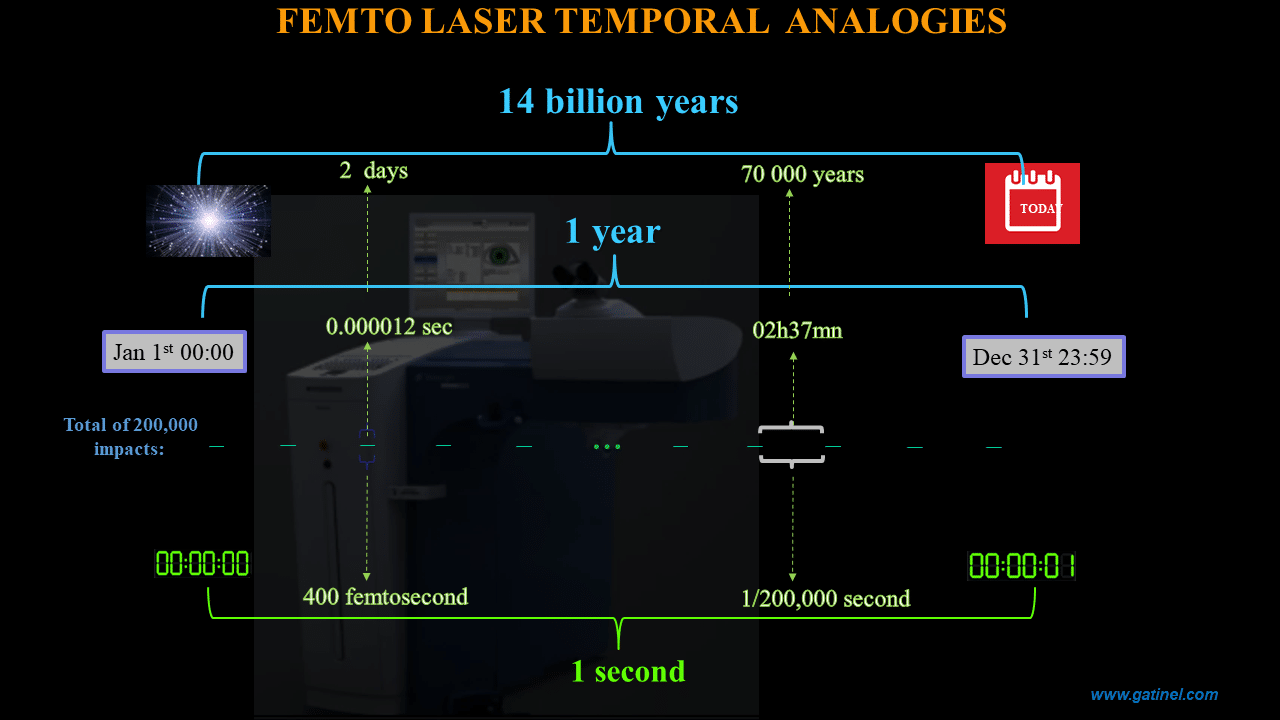
If 1 second = age of Universe (14 billion years), then 1 fs = 8 minutes
The total duration of light pulses emitted by femtosecond lasers used in corneal surgery equals a few hundred femtoseconds (typically 300-500 fs).
400 fs laser pulse at different time scales
| If 1 second equals… | Then 400 fs pulse equals… |
|---|---|
| 1 year | ~0.000012 seconds (10 millionths of a second) |
| Age of the Universe (14 billion years) | ~2 days |
How far does light travel in 400 femtoseconds?
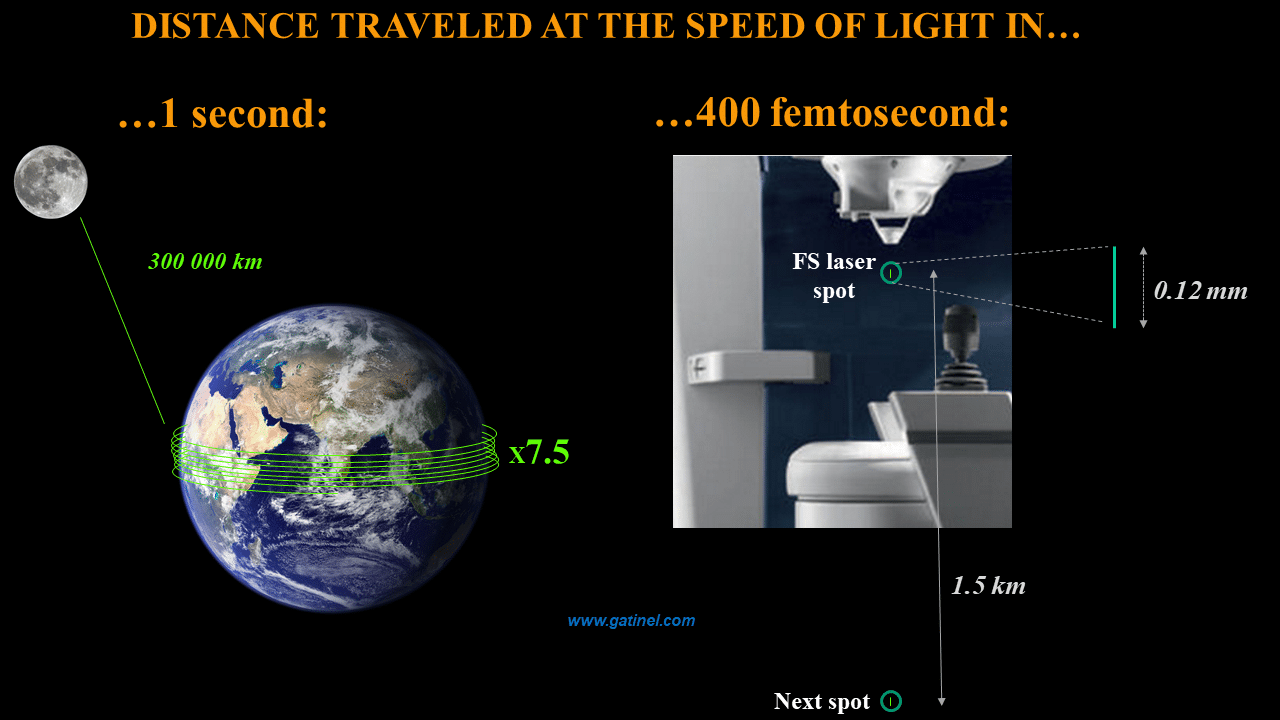
To represent the swiftness of femtosecond pulses, let us consider the distance traveled by light during a 400 fs pulse.
Hence, during 400 femtoseconds, the leading edge of the laser light pulse has time to cover only 0.12 millimeters (120 microns)! This is about the thickness of a human hair.
What is the firing frequency?
The firing frequency corresponds to the number of laser pulses per unit of time. Modern femtosecond lasers used in clinical practice operate at frequencies up to 500 kHz or higher.
WaveLight FS200 (Alcon)
200 kHz
200,000 spots/second
Ziemer Z8
>2 MHz
Low energy, high frequency
Cosmic scale analogy (200 kHz)
- If pulses encountered no obstacle, the distance between successive 100 µm long waves would be approximately 1.5 km
- If 1 second = 1 year, the time interval between each spot would stretch to about 2.5 hours
- At the scale of the Universe’s age: each pulse would emit for 2 consecutive days, with a 70,000-year gap between shots
What is the spot energy?
The energy of each impact is of the order of a microjoule (10−6 Joule) — one-millionth of a Joule.
1 Joule =
Energy required to lift an object of 100 g (like an apple) over a height of 1 meter
1 Microjoule =
Energy required to lift 100 g over the distance of 1 micron (0.000001 m)
Key point: Power vs Energy
Power = Energy / Time. The extraordinary swiftness of the femtosecond pulses provides sufficient instantaneous power to break corneal tissue at the focal point through photodisruption — separating electrons from their atomic nuclei and creating microscopic cavitation bubbles (diameter: a few microns).
How many spots create the LASIK flap interface?
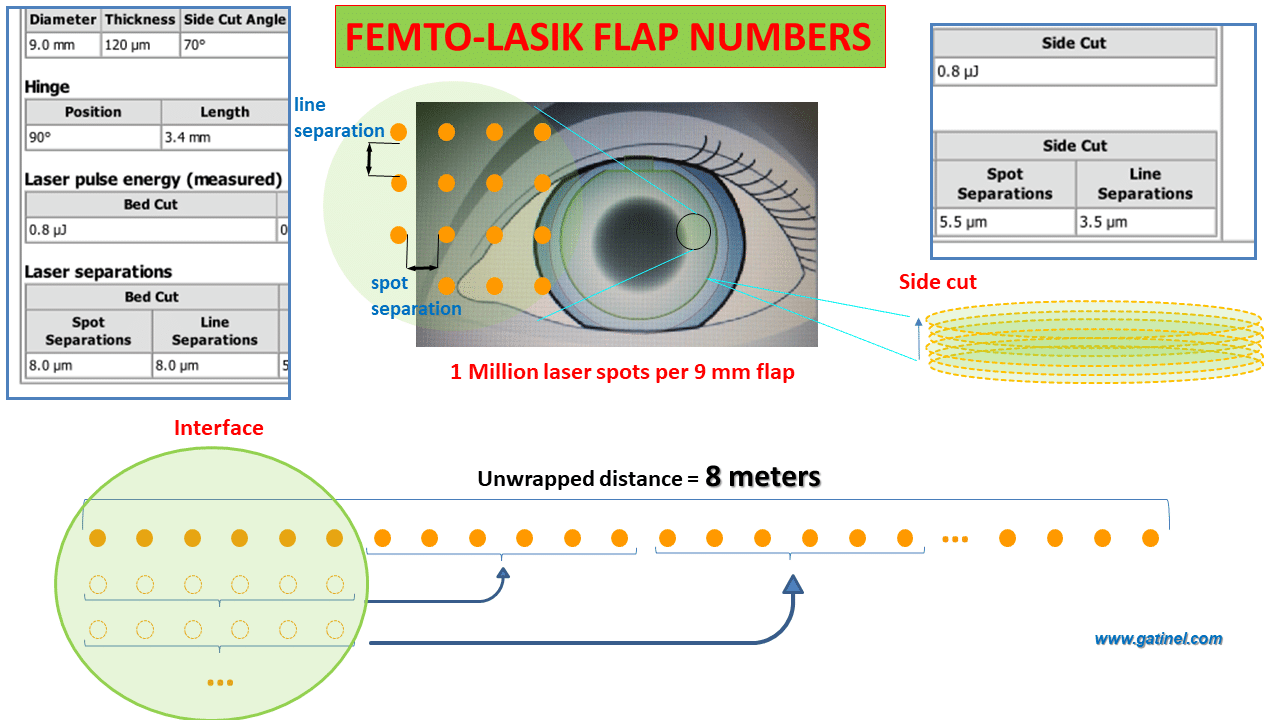
To create the LASIK flap interface, the 400 fs laser shots are focused at a controlled depth from the corneal surface and distributed to form a juxtaposition of dotted lines, with typical spot and line spacing of 8 microns.
If all spots were drawn along a single line, they would cover a total distance of approximately 8 meters. This 8-micron-spaced dotted line would be drawn at a speed of 5.7 km/h in about 5 seconds.
⚠️ Spot spacing matters
Dividing the spot spacing by 2 (from 8 to 4 microns) results in 2² = 4-fold increase in the number of spots for the same flap diameter. For the same firing frequency (200 kHz), this would increase the interface creation time from 5 to 20 seconds.
How many spots create the side cut?
The spot and line spacings are usually different and coarser for the side cut than for the interface. The number of spots required depends on flap thickness and diameter.
Example: 9 mm flap, 100 µm thickness
- Spot separation: 5.5 µm
- Spots per circular pattern: ~5,000
- Line spacing: 3.5 µm
- Stack of circular patterns: ~30
- Total spots for side cut: ~150,000
- Duration at 200 kHz: <1 second
Summary: A typical Femto-LASIK flap
1 Joule
Total energy
<10 sec
Total duration
~1.15 M
Total spots
8 meters
Linear path length
Current Technology (2024)
Five generations of femtosecond lasers have been introduced for refractive surgery. Modern platforms offer:
- Higher frequencies (up to 500+ kHz) for faster procedures
- Lower energy per pulse to minimize tissue damage and inflammation
- Tighter spot spacing for smoother flap beds
- 3D flap designs with angled side cuts for improved biomechanics
- Flap thickness precision: standard deviation as low as 4 µm
- Diameter accuracy: mean difference <0.05 mm from intended
References
AAO & Review Articles
- Farjo AA, Sugar A, Schallhorn SC, et al. Femtosecond lasers for LASIK flap creation: a report by the American Academy of Ophthalmology. Ophthalmology. 2013;120(3):e5-e20. [PubMed]
- Ahn H, Kim JK, Kim CK, et al. Comparison of lasik flap thickness using three femtosecond lasers. Int Ophthalmol. 2019;39(7):1527-1537.
- EyeWiki. Femtosecond Lasers and Laser Assisted in Situ Keratomileusis (LASIK). American Academy of Ophthalmology. [EyeWiki]
Flap Accuracy & Precision (2023-2024)
- Wexler S, Hall B, et al. The Accuracy of Flap Thickness and Diameter in LASIK Using a Femtosecond Laser. Clin Ophthalmol. 2023;17:3877-3882. [PMC]
- Vinciguerra R, Vinciguerra P, et al. Creation of a Corneal Flap for LASIK Using a Three-Dimensional Femtosecond Laser Cut. Optics. 2024;5(2):19. [MDPI]
- Steinberg J, et al. Safety and Precision of Two Different Flap-morphologies Created During Low Energy Femtosecond Laser-assisted LASIK. J Ophthalmic Vis Res. 2023;18(1):3-14. [PMC]
- Kanellopoulos AJ, Asimellis G. Digital analysis of flap parameter accuracy and objective assessment of opaque bubble layer in femtosecond laser-assisted LASIK. Clin Ophthalmol. 2013;7:343-351. [PMC]
Femtosecond Laser Physics & Technology
- Soong HK, Malta JB. Femtosecond lasers in ophthalmology. Am J Ophthalmol. 2009;147(2):189-197.
- Chung SH, Mazur E. Surgical applications of femtosecond lasers. J Biophotonics. 2009;2(10):557-572.
- Lubatschowski H. Overview of commercially available femtosecond lasers in refractive surgery. J Refract Surg. 2008;24(1):S102-S107.
- Ratkay-Traub I, Juhasz T, Horvath C, et al. Ultra-short pulse (femtosecond) laser surgery: initial use in LASIK flap creation. Ophthalmol Clin North Am. 2001;14(2):347-355.
Complications & Comparisons
- Kanclerz P, Khoramnia R. Flap Thickness and the Risk of Complications in Mechanical Microkeratome and Femtosecond Laser In Situ Keratomileusis. Diagnostics. 2021;11(9):1588.
- Durrie DS, Kezirian GM. Femtosecond laser versus mechanical keratome flaps in wavefront guided LASIK: prospective contralateral eye study. J Cataract Refract Surg. 2005;31(1):120-126.
- Slade SG. The use of the femtosecond laser in the customization of corneal flaps in LASIK. Curr Opin Ophthalmol. 2007;18(4):314-317.
Related pages
Last updated: February 2026
Laisser un commentaire