PRESBYpath — Personalised Pseudo-Accommodative Profile Designer
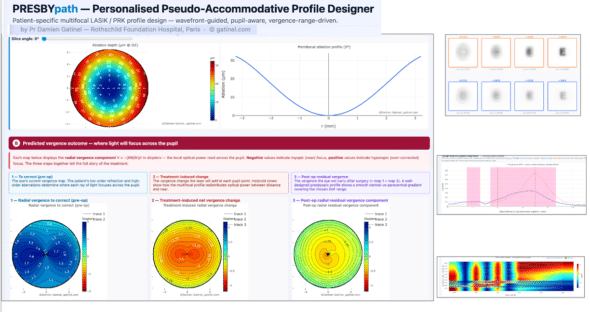
This interactive presbyopic-LASIK designer turns a patient’s refraction, keratometry, asphericity and high-order wavefront into a fully personalised multifocal corneal profile. The optimiser co-designs the asphericity change (ΔQ) — or, alternatively, a target radial-Zernike combination (Z40, Z60, Z80) — together with a spherical add, so that through-focus image quality covers the chosen pseudo-accommodative vergence range at two pupil sizes simultaneously: the mesopic / distance pupil and the constricted / near pupil. Two laser-programming routes are offered side by side: Q-asphericity modulation (clinical refraction + target post-op Q on each meridian, biconic engine) and spherical-aberration modulation (target wavefront expressed as radial Zernike modes). Both share an identical patient-specific scoring objective — a combined image-quality index built from through-focus MTF, MTFa, PSF, Strehl ratio and depth of focus, all evaluated across the chosen vergence range and both pupils. The originality of PRESBYpath lies in its vergence-map readout: instead of showing the wavefront in microns of OPD, the platform displays the local optical power across the pupil in diopters (radial vergence component V ≈ −(∂W/∂r)/r), split into total, low-order and high-order contributions — the very units used to prescribe glasses, contact lenses or IOLs. The interface guides the clinician through a 5-step workflow: refraction & corneal geometry → wavefront analysis (Zernike pyramid editable; a one-click typical Z(4,0) fallback is provided when no aberrometry is available) → treatment design (pupil pair, vergence range, strategy) → live optimisation with a narrated heatmap of the search landscape → results page with laser-entry values, ablation profile audit, through-focus MTFa curves, multi-frequency MTF, PSF strip and simulated optotype rendering. The same optimisation framework extends conceptually to multifocal contact lenses, multifocal / EDOF IOLs and piggyback designs — the substrate changes, the optical problem does not.
For education and simulation only — not a certified medical device. The output is a theoretical optical design; clinical nomograms (regression-compensating overcorrection, transition-zone strategy, vendor-specific ablation calibration) remain the surgeon’s responsibility.